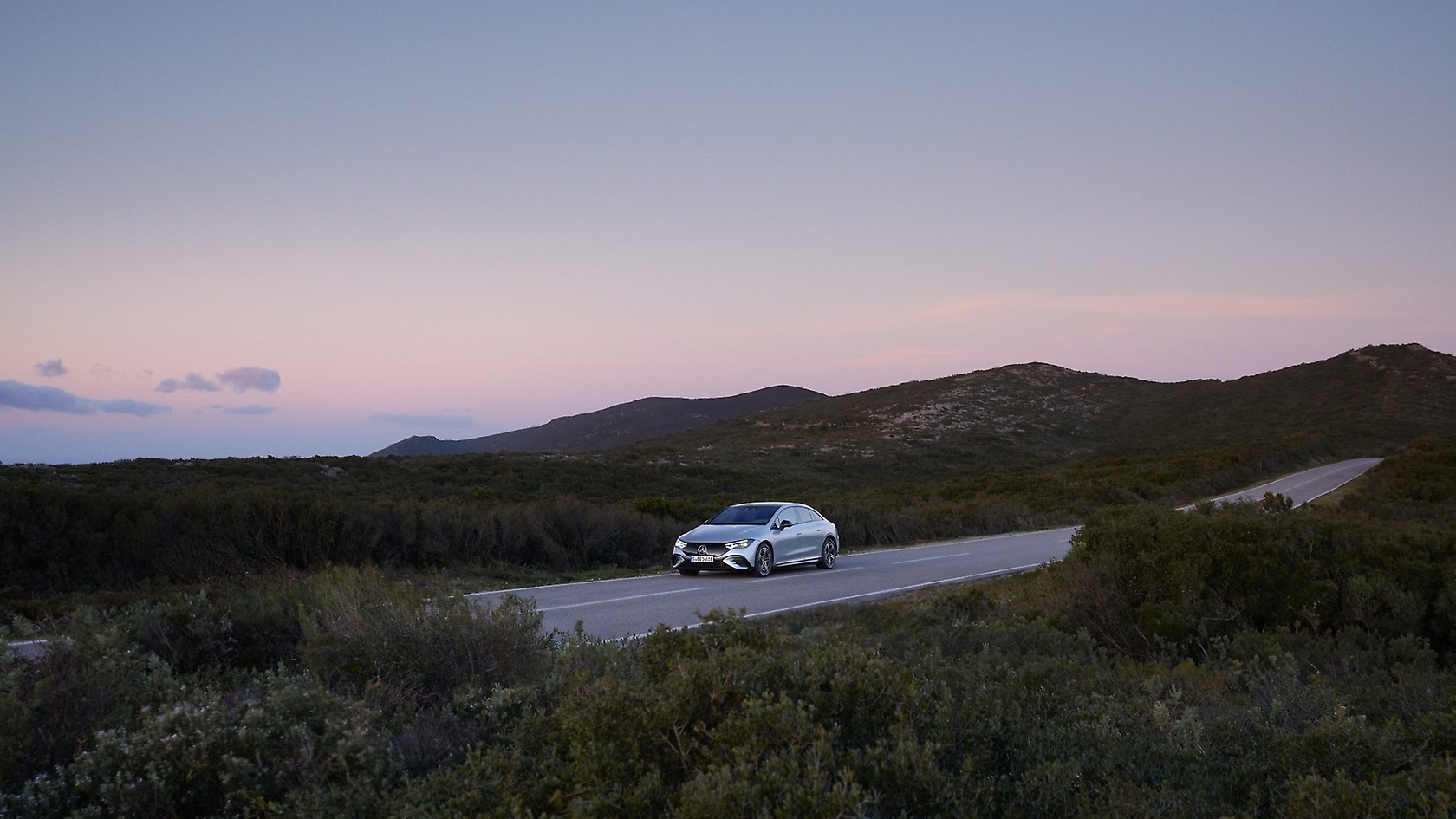
Mercedes-Benz EQE.

Moving Charging Forward with a Pioneering Spirit

Tomorrow drives Mercedes-Benz.

Since we invented the automobile 140 years ago, Mercedes-Benz has always been driven by tomorrow to develop and enhance individual mobility. We’ve been continuously paving the way for future mobility and we want to be better at everything we do – in comfort, engineering, design and in developing and producing our vehicles with a reduced environmental impact.

Mercedes-Benz is committed to creating the most desirable cars as efficiently as possible.

But what does it mean?

We have anchored environmental responsibility in our business strategy. We are aiming to apply it to all our activities.

The ambition[1]The ambition of the Mercedes-Benz Group is by 2039 to reduce its CO₂ emissions by 90% in its own production, by 80% in the vehicle use phase, where market conditions permit, and by 70% across all relevant stages of the value chain, compared to 2019. In addition, the Mercedes-Benz Group supports qualified climate change mitigation projects that meet recognized standards.
By 2049 at the latest, the Mercedes-Benz Group intends to achieve net-zero. Net-zero means that the CO₂ emissions will be reduced by at least 90% compared to 2019. Remaining CO₂ emissions (< 10%) will be neutralized permanently.
of Mercedes-Benz Group is to reduce its CO₂ emissions by 2039 by 90 % in own production, by 80 % in vehicle use phase – as market conditions allow – and overall by 70 % across all relevant value chain stages compared to 2019. In addition, the Mercedes-Benz Group supports qualified climate change mitigation projects that meet recognised standards. By 2049 at the latest, the Mercedes-Benz Group intends to achieve net zero. Net zero means that the CO₂ emissions across all relevant value chain stages will be reduced by at least 90 % compared to 2019. Remaining CO₂ emissions (< 10 %) will be neutralised permanently.

We have already reached some important milestones. So read the signs in our video and join us on our drive into tomorrow.
Our activities along the value chain:

Design for Environment Close

At Mercedes-Benz, sustainability does not begin with automobile production, but rather in the early stages of product development. We call this “Design for Environment” and are taking a holistic approach – both in terms of the reduction of CO2 emissions and less consumption of natural resources.

Supplier chain Close

Together with our partners in the supply chain, we want to implement effective climate protection measures. Mercedes-Benz has strategically established partnerships to help decarbonise the supply chain. Already today, for example, Mercedes-Benz sources CO₂-reduced aluminium that comes from electrolysis powered by renewable energy.

Careful use of resources Close

We are working intensively on closing material cycles, increasing the share of recycled materials in our vehicles and researching new materials to keep the consumption of primary resources as low as possible right from the start. The focus components include aluminium, steel, and battery cells.

Carbon emissions in the production Close

The ambition[1]The ambition of the Mercedes-Benz Group is by 2039 to reduce its CO₂ emissions by 90% in its own production, by 80% in the vehicle use phase, where market conditions permit, and by 70% across all relevant stages of the value chain, compared to 2019. In addition, the Mercedes-Benz Group supports qualified climate change mitigation projects that meet recognized standards.
By 2049 at the latest, the Mercedes-Benz Group intends to achieve net-zero. Net-zero means that the CO₂ emissions will be reduced by at least 90% compared to 2019. Remaining CO₂ emissions (< 10%) will be neutralized permanently.
of Mercedes-Benz Group is to reduce its CO₂ emissions by 2039 by 90 % in own production, by 80 % in vehicle use phase – as market conditions allow – and overall by 70 % across all relevant value chain stages compared to 2019. In addition, the Mercedes-Benz Group supports qualified climate change mitigation projects that meet recognised standards. By 2049 at the latest, the Mercedes-Benz Group intends to achieve net zero. Net zero means that the CO₂ emissions across all relevant value chain stages will be reduced by at least 90 % compared to 2019. Remaining CO₂ emissions (< 10 %) will be neutralised permanently.

Electric fleet Close

We already offer a broad portfolio of battery-electric vehicles – from the compact EQA to the spacious EQE SUV. From mid of the decade onwards, all new vehicle architectures will be exclusively electric.

Renewable Charging Close

Mercedes-Benz consistently relies on the use of electricity from renewable energies. Renewable Charging[2]Renewable Charging is an integral part of MB.CHARGE Public in Europe, the USA, Canada and China. If electricity from renewable energies is not yet available at the respective charging station, Renewable Charging uses Energy Attribute Certificates. These ensure that an equivalent amount of electricity from renewable energies is fed into the power grid for charging processes via MB.CHARGE Public. They are from wind and solar power plants which are less than six years old.
is an integral part of MB.CHARGE Public in Europe, the USA, Canada and China. If electricity from renewable energies is not yet available at the respective charging station, Renewable Charging[2]Renewable Charging is an integral part of MB.CHARGE Public in Europe, the USA, Canada and China. If electricity from renewable energies is not yet available at the respective charging station, Renewable Charging uses Energy Attribute Certificates. These ensure that an equivalent amount of electricity from renewable energies is fed into the power grid for charging processes via MB.CHARGE Public. They are from wind and solar power plants which are less than six years old.
uses Energy Attribute Certificates (incl. EKOenergy ecolabel). These ensure that an equivalent amount of electricity from renewable energies is fed into the power grid for charging processes via MB.CHARGE Public. They are from wind and solar power plants which are less than six years old. They are from wind and solar power plants which are less than six years old.

This article was last updated in September 2026.

The all-new electric CLA

Sustainability – an overview.

Here you can find an overview with more details of our focus areas and strategy, as well as news and insights on the entire sustainability topic.