April 02, 2026 – For 140 years, Mercedes Benz has been shaping the future of mobility, beginning with the invention of the automobile. In the new EQS, this claim to technological leadership can once again be experienced.
,xPosition=0,yPosition=0.5)
Pioneering spirit reloaded
Mercedes-Benz AG
Mercedesstraße 120
70372 Stuttgart
Germany
Phone: +49 7 11 17-0
E-Mail: dialog@mercedes-benz.com
Please send queries about content on this website to any contact. You can address your concerns to us in English and your respective national language.
Represented by the Board of Management:
Ola Källenius, Chairman; Jörg Burzer, Mathias Geisen, Olaf Schick, Michael Schiebe, Britta Seeger, Oliver Thöne, Harald Wilhelm
Chairman of the Supervisory Board: Martin Brudermüller
Court of Registry: Stuttgart; commercial register no. 762873
VAT ID: DE 32 12 81 763
All information about our products can be found on your country-specific Mercedes-Benz product page.
Pioneering spirit reloaded
April 02, 2026 – For 140 years, Mercedes Benz has been shaping the future of mobility, beginning with the invention of the automobile. In the new EQS, this claim to technological leadership can once again be experienced.
Just a few months after its market launch, it will be available with steer-by-wire technology. As the first German car manufacturer, Mercedes-Benz will thus offer a production vehicle with this technology. Steer-by-wire technology elevates the driving experience to a new level and fundamentally transforms the interaction between human and vehicle. Precise, intuitive and effortless – that's how the new generation of steering feels in the new EQS.
The completely new steering feel provides a unique experience and offers a wide range of advantages in everyday driving – driving dynamics benefit from it, while manoeuvring and parking become even easier. This is because the effort required can be further reduced and there is no longer a need to adjust the grip on the steering wheel.
Undesired vibrations caused by uneven road surfaces, which were previously transmitted to the driver via the steering wheel, can now be eliminated. The tyre-road contact is calculated on a model-by-model basis with the help of the restoring forces of the steered wheels. Precise, intuitive steering feel is maintained, preserving the characteristic Mercedes Benz steering.
Steer-by-wire also gives the interior a new look: a flatter steering wheel noticeably opens up the space, improves the view of the driver display and makes it easier to get in and out of the car. This reinforces the brand’s signature “Welcome home.” feeling from the very first moment.
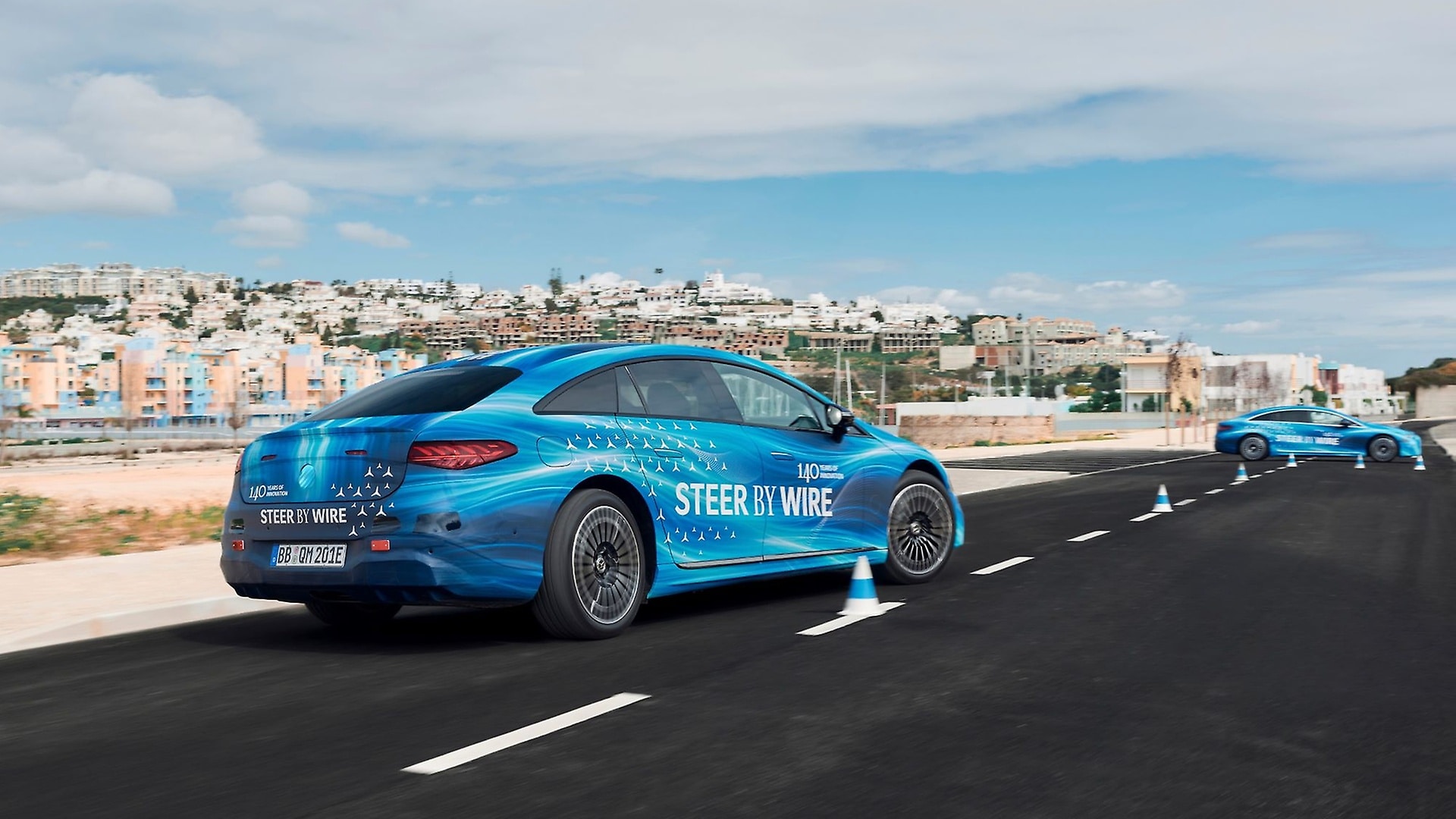
Driving characteristics that were previously in conflict with each other have been optimised at the same time: the EQS now combines sportiness and comfort even more effectively, while further enhancing driving stability and lateral agility. This is because the suspension specialists have flexibly adapted the steering ratio to different situations. Added to this is the perfect interaction with the rear-axle steering. At higher speeds, the rear wheels steer parallel to the front wheels, ensuring reassuring stability and a safe driving experience.
The new steer-by-wire system has already completed over a million test kilometres on test benches, test tracks and in overall vehicle validation in road traffic. In line with its high safety standards, Mercedes Benz relies on a redundant system architecture in addition to high-precision sensors and powerful control units. This means that there are basically two signal paths. This ensures that steering capability is always guaranteed. Even in the unlikely event of a complete failure, lateral control is still possible thanks to rear-axle steering and targeted wheel-specific braking interventions via the ESP®.
On the EQS, the steer‑by‑wire system is available in combination with all powertrains and the 10‑degree rear‑axle steering. As an alternative to the optional steer-by-wire system, Mercedes Benz continues to offer an electromechanical steering.
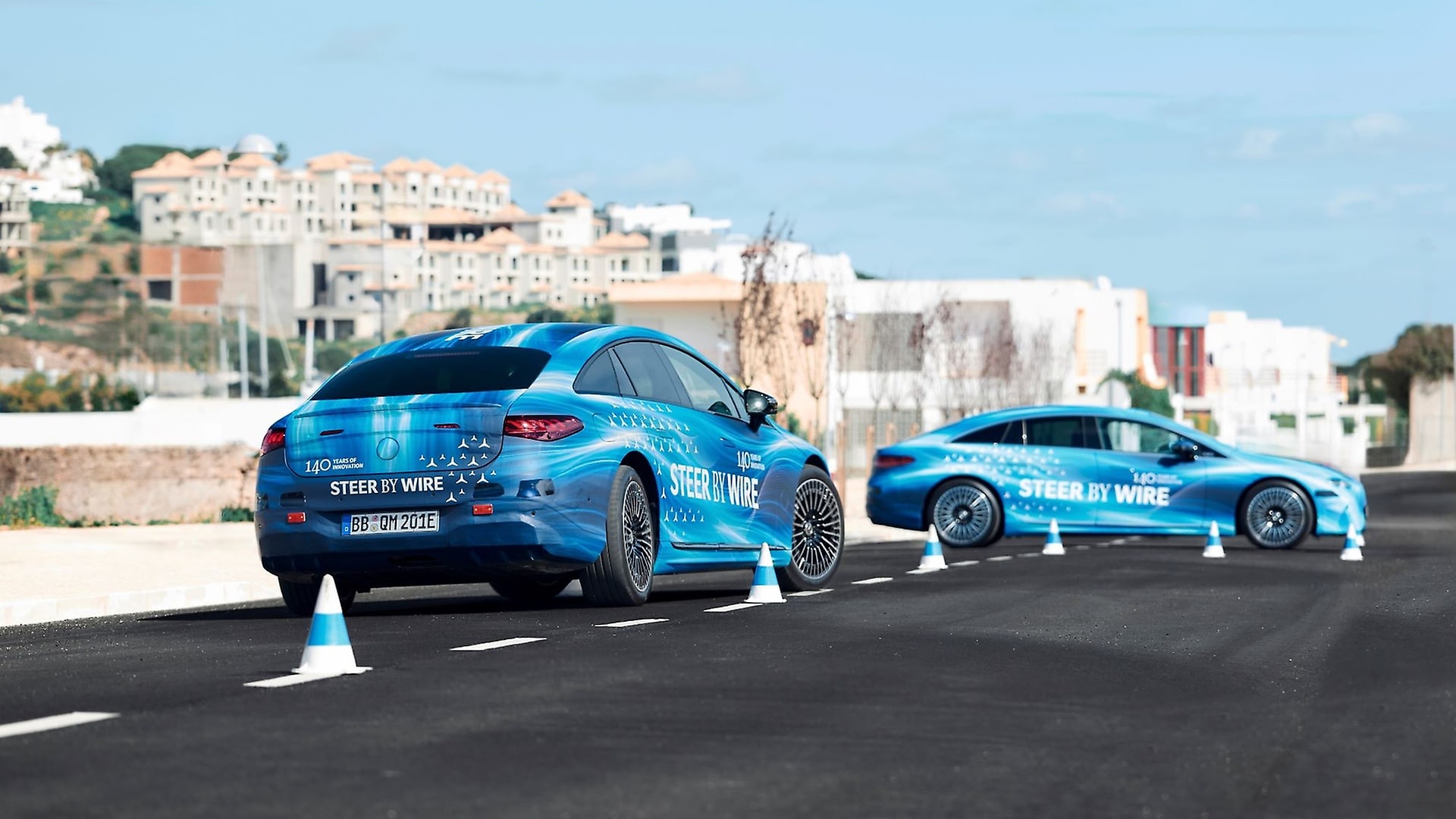
In the new EQS, Mercedes Benz uses the steer-by-wire technology for a flattened, more compact steering wheel and combines it with a newly developed airbag structure. Since the airbag can no longer “support” itself on a closed steering wheel rim, an internal support and folding architecture takes over the controlled shaping during deployment. This requires a high degree of technological expertise.
The throttle routing, folding pattern and holding points have been designed in such a way that the airbag is positioned in a stable and reproducible manner, even without the upper steering wheel rim. At the same time, the system is integrated into the steering wheel hub as before and, even with the modified steering wheel design, meets the unchanged high restraint and safety requirements. This solution underlines Mercedes Benz's holistic approach to innovation, in which new vehicle architectures are consistently redesigned down to the last detail of passive safety.
,xPosition=1.0,yPosition=0)