Visual GLB Q3 2026.

Mercedes-Benz Group reports Q3 EBIT of €1.77 billion

Financial Services and Vans with significant contribution; record BEV sales.

Q3 2026 Q2 2026 Q1 2026 Q3 2025 Q2 2025 Q1 2025 more

October 28, 2026 – Mercedes-Benz Group AG (ticker symbol: MBG) reported revenue of €30.7 billion in the third quarter of 2026 (Q3 2025: €32.1 billion), Group EBIT of €1.77 billion (Q3 2025: €0.75 billion) and net profit of €1.52 billion (Q3 2025: €1.19 billion). The increase in reported EBIT mainly reflected lower adjustments than in the prior-year quarter. Adjusted Group EBIT decreased by 15% to €1.78 billion (Q3 2025: €2.10 billion).

You will find all documents and the recordings of the conference calls in the lower section of this page.

Ola Källenius.

Continued sales growth in Europe and the United States and record BEV sales show that our new models are resonating with customers. At the same time, market conditions have become even more challenging over the course of the year, particularly in China. Consistent cost discipline and strong contributions from Mercedes-Benz Vans and Mercedes-Benz Financial Services help us counter these headwinds, while our strong balance sheet allows us to keep investing in our future. With more product launches ahead and AI changing the way we work, we are focused on building a faster, more efficient and even more competitive Mercedes-Benz.

Ola Källenius
Chief Executive Officer of Mercedes-Benz Group AG
Ola Källenius.

Earnings were supported by higher unit sales in Europe and the United States, strong profitability at Mercedes-Benz Financial Services and Mercedes-Benz Vans, and the disciplined execution of efficiency measures across the company. Currency headwinds and a more challenging market environment in China, including further intensifying competition, weighed on the results.

The Group maintained its strict cost discipline. In the first nine months, investments in property, plant and equipment and research and development expenditure at Mercedes-Benz Cars decreased by a total of 11%, following last year’s investment peak for the product launch programme. Since June 2026, the company has further intensified its global productivity measures, with a particular focus on its German locations. This builds on a reduction in fixed costs of approximately 25% since 2019. As part of these measures, it will again offer its voluntary severance programme for indirect functions in Germany starting December 2026.

Strong financial position

In the first nine months, the Mercedes-Benz Group spent €6.4 billion on research and development and invested €2.9 billion in property, plant and equipment, while returning €5.2 billion to shareholders through dividend payments and share repurchases. Net liquidity of the industrial business nevertheless remained close to the year-end level at €31.0 billion (31 December 2025: €32.2 billion) and increased slightly compared with the end of the second quarter. The funding ratio of the pension plans improved to 119% (year-end 2025: 113%). These figures underline the Group’s ability to keep investing in its product and technology programme while continuing to return capital to shareholders.

Free cash flow of the industrial business reached €3.1 billion in the first nine months (Q1-Q3 2025: €5.6 billion), including cash outflows of approximately €1.1 billion for restructuring measures, mainly related to the voluntary severance programme in Germany. Lower income-tax payments and proceeds of €1.0 billion from the partial sale of Daimler Truck shares had a positive effect. Free cash flow of the industrial business amounted to €172 million in the third quarter (Q3 2025: €1,367 million), mainly reflecting a build-up of working capital, in particular higher inventories of new vehicles which are expected to reach customers in the coming months.

Divisional results

Mercedes-Benz Cars Close

Reported EBIT of Mercedes-Benz Cars increased by 5.8% to €455 million (Q3 2025: €430 million). Adjusted EBIT amounted to €560 million (Q3 2025: €1,139 million), corresponding to an adjusted return on sales of 2.5% in the third quarter (Q3 2025: 4.8%). In the first nine months, the adjusted return on sales reached 3.5%. Benefits from efficiency measures partly offset currency effects, a lower earnings contribution from the Chinese market, as well as higher expenditure for market-launch campaigns and product lifecycle measures amid the execution of the company’s largest-ever product launch programme.

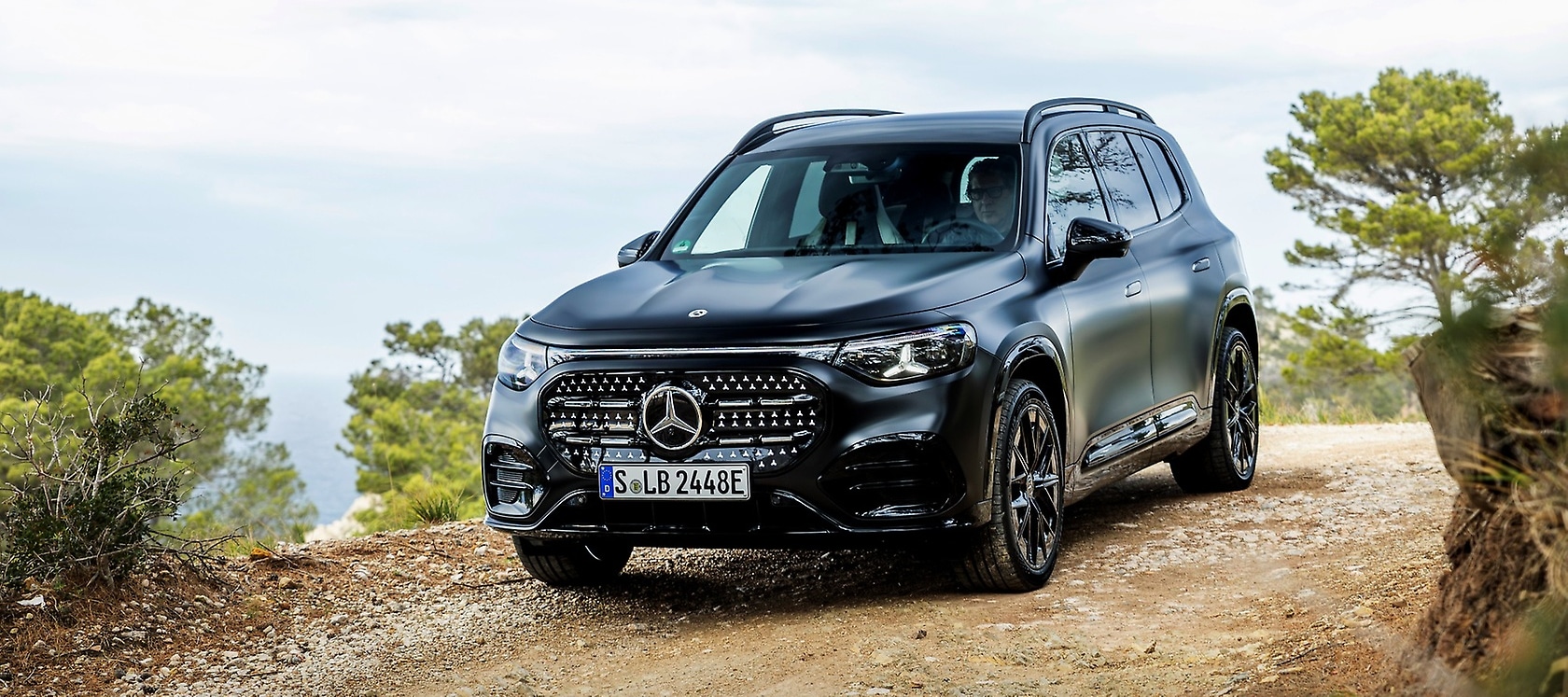
Mercedes-Benz Cars continued to execute its product launch programme, with clear momentum from its new model portfolio. Total sales outside China developed positively in the third quarter, supported by growth in Europe (+5%), particularly in Germany (+13%), and in the United States (+6%). Supported by the continued rollout of new models, product momentum has contributed to three consecutive quarters of sales growth outside China. In the third quarter, Mercedes-Benz Cars achieved its highest-ever quarterly BEV sales, up 61% year-on-year and 29% compared with the second quarter. The global BEV share reached an all-time high of 16.8%, while BEVs and plug-in hybrids together accounted for 25% of global car sales. In Europe, almost one in two cars sold was electrified (xEV), and every third was fully electric. Customer demand for the new electric portfolio remains strong, with order books for key models in Europe extending well into 2027. Sales of the Core segment outside China increased, driven by significant growth in Europe and a positive contribution from the electric GLC, which was awarded “German Premium Car of the Year 2027”. The ramp-up of the all-new CLA, awarded “Car of the Year 2026” and “Best Performer” in Euro NCAP, supported sales in the Entry segment. The S-Class is seeing strong customer demand as the new model ramps up, with sales outside China more than doubling compared with the second quarter. In October, the new S-Class was awarded “2027 MotorTrend Car of the Year”. Overall, Mercedes-Benz Cars sold 407,232 vehicles (Q3 2025: 441,453), down 8%, primarily reflecting challenging market conditions and intense competition in China.

The new model portfolio is also bringing the company’s technology programme to customers at scale. MB.OS, the in-house Mercedes-Benz operating system, is being introduced in all new or updated models, regardless of powertrain. Every new Mercedes-Benz is therefore software-defined and can be updated over the air across all vehicle domains, including driver assistance. Following China and the United States, point-to-point assisted driving is set to launch in the first German cities by the end of 2026. In automated driving, Mercedes-Benz and NVIDIA will expand their strategic partnership to jointly develop the next generation of driver-assistance and automated-driving systems, combining Mercedes-Benz engineering and MB.OS with NVIDIA’s computing and AI technologies. On the powertrain side, Mercedes-Benz continues to offer customers both all-electric vehicles and high-tech combustion engines with 48-volt hybrid technology, without compromise.

Earlier this month, Mercedes-AMG presented the new Mercedes-AMG GT SUV. The first full-size SUV developed entirely in-house in the brand’s 59-year history is the second new model based on the AMG.EA high-performance architecture, following the recently unveiled Mercedes-AMG GT 4-Door Coupé.

Mercedes-Benz Vans Close

With an adjusted return on sales of 9.4%, Mercedes-Benz Vans remained in the upper half of the guidance range in the third quarter. In the first nine months, the adjusted return on sales reached 9.9%, at the upper end of the range. At €397 million, adjusted EBIT was slightly below the prior-year level, reflecting net pricing pressure and ramp-up activities for the new Van Architecture as part of the largest product investment programme in the history of Mercedes-Benz Vans. At the same time, higher sales outside China and lower expenditure on product-related measures had a positive impact. Mercedes-Benz Vans recorded third-quarter sales of 84,421 units, an increase of 1% globally, mainly driven by a strong performance in the Rest of the World region (+25%) and in North America (+8%), along with double-digit growth for eVans (+12%) compared with the third quarter of 2025.

In September, Mercedes-Benz Vans showcased its comprehensive commercial van portfolio and the Mercedes-Benz PRO business ecosystem at IAA Transportation 2026. Together, the vehicle and digital solutions create added value for professional customers. The all-new electric VLE was another key highlight, presented in an eight-seater variant for use as a professional shuttle vehicle.

Mercedes-Benz Financial Services Close

Mercedes-Benz Financial Services delivered strong results in the third quarter of 2026. Adjusted EBIT increased by 42% to €445 million in the quarter (Q3 2025: €313 million) and by 52% to €1.35 billion in the first nine months. The increase was supported by continued improvements in portfolio margins, a favourable development in cost of credit risk and disciplined cost management. The adjusted return on equity increased to 13.8% in the quarter (Q3 2025: 9.6%). Nearly one in two vehicles sold was financed or leased through Mercedes-Benz Financial Services.

Total contract volume decreased to €123.7 billion as of 30 September 2026 (€128.8 billion as of 31 December 2025), mainly reflecting the completion of the Athlon sale in July. New business amounted to €40.4 billion in the first nine months of 2026, compared with €41.2 billion in the prior-year period.

The results underline the resilience of Mercedes-Benz Financial Services’ business model and its continued contribution to the Group’s profitability in a challenging market environment.

Strategic progress and AI transformation

Mercedes-Benz is using artificial intelligence to transform the way it works across all functions – from R&D and production to sales and administration. The aim is to increase speed, productivity and efficiency and to strengthen the company’s competitiveness. One example is PLM.AI, a new AI-native digital backbone for global product development that connects development, procurement, production, sales and after-sales. It is designed to shorten development times by up to 30%. In production, Mercedes-Benz already uses AI applications in its MO360 digital ecosystem, for example, ensuring consistently high quality. In administration and sales, Mercedes-Benz is systematically automating workflows and redesigning processes end-to-end with AI to accelerate decisions, reduce complexity and free up resources for innovation.

Recording call for analysts and investors

Recording media conference call

Download

This page contains forward-looking statements.

Key figures.

Group, divisions, downloadable tables.

Outlook.

Outlook on the further business development of the Mercedes-Benz Group.