Sustainability Dialogue 2026.

Mercedes-Benz enhances transparency of its CO₂ reduction pathway

First Movers Coalition and Hydro offtake agreement.

November 10, 2026 – Mercedes-Benz remains committed to advancing decarbonisation and circularity as part of its transformation plans, management processes, product development and business operations. Mercedes-Benz enhanced the transparency of its CO₂ reduction pathway and took further steps to decarbonise its supply chain, even amid volatile market conditions and heightened geopolitical uncertainty and while taking into account customer demand and infrastructure development.
Mercedes-Benz presented its detailed CO₂ reduction steps at its Sustainability Dialogue x Sustainability Update in Sindelfingen, along with its more focused sustainable business strategy. Mercedes-Benz remains committed to reducing emissions at source, driven by the electrification of its vehicle fleet, the use of renewable energy in production and through the use of low carbon and circular materials in production. That is why Mercedes-Benz Group is today outlining its commitment to a 90% reduction in production emissions, an 80% cut in use-phase emissions as market conditions allow, and an overall 70% reduction in CO₂ across all relevant value chain stages by 2039 compared to 2019. Beyond 2039, Mercedes-Benz will continue its ambitious reduction pathway, targeting net zero in the course of the following decade. Net-zero means that the CO₂ emissions will be reduced by at least 90% compared to 2019. Remaining CO₂ emissions (< 10%) will be neutralized permanently. (further information see CTAP)

Even in challenging market conditions, Mercedes-Benz puts sustainability at the core of its strategy alongside resilience and competitiveness. With the enhanced transparency of Ambition 2039[1]The ambition of Mercedes-Benz Group is to reduce its CO₂ emissions by 2039 by 90 % in own production, by 80 % in vehicle use phase – as market conditions allow – and overall by 70 % across all relevant value chain stages compared to 2019. In addition, the Mercedes-Benz Group supports qualified climate change mitigation projects that meet recognized standards.
By 2049 at the latest, the Mercedes-Benz Group intends to achieve net-zero. Net-zero means that the CO₂ emissions will be reduced by at least 90% compared to 2019. Remaining CO₂ emissions (< 10%) will be neutralized permanently.
(further information see CTAP).
we are outlining new milestones in our decarbonisation pathway to turn sustainability into operational reality: tangible, measurable and infused into the heart of our products. The latest example is our all-electric GLC which has reduced its CO₂ emissions by around two thirds compared to its non-electric predecessor model.

Olaf Schick
Member of the Board of Management of Mercedes-Benz Group AG, Integrity, Governance & Sustainability

Our CO₂ reduction efforts are supported by continued product momentum. Between 2025 and 2027 alone, Mercedes-Benz plans to launch 14 fully electric vehicles. Furthermore, the company continues to benefit from its use of renewable energy which already covers 51% of total energy consumption at Mercedes-Benz Cars production sites and by 39% at Mercedes-Benz Vans. Today, 100% of externally sourced electricity worldwide comes from renewable sources.

Sharper focus: Recalibrated to four areas

Sustainability is a guiding principle of the Mercedes-Benz strategy and a key factor for the resilience and long-term success of its business. From 2027, Mercedes-Benz will sharpen its Sustainable Business Strategy by focusing on four strategic topics, further strengthening the link between sustainability, business relevance and measurable impact:

  • Decarbonisation: decarbonising the core business along the value chain in line with Ambition 2039[1]The ambition of Mercedes-Benz Group is to reduce its CO₂ emissions by 2039 by 90 % in own production, by 80 % in vehicle use phase – as market conditions allow – and overall by 70 % across all relevant value chain stages compared to 2019. In addition, the Mercedes-Benz Group supports qualified climate change mitigation projects that meet recognized standards.
    By 2049 at the latest, the Mercedes-Benz Group intends to achieve net-zero. Net-zero means that the CO₂ emissions will be reduced by at least 90% compared to 2019. Remaining CO₂ emissions (< 10%) will be neutralized permanently.
    (further information see CTAP).
    , with a focus on electrification and on supply chain, logistics and production.
  • Circularity: decoupling resource consumption from volume growth and increasing the use of secondary raw materials to 40 percent within the next decade, in line with Ambition 2039.[1]The ambition of Mercedes-Benz Group is to reduce its CO₂ emissions by 2039 by 90 % in own production, by 80 % in vehicle use phase – as market conditions allow – and overall by 70 % across all relevant value chain stages compared to 2019. In addition, the Mercedes-Benz Group supports qualified climate change mitigation projects that meet recognized standards.
    By 2049 at the latest, the Mercedes-Benz Group intends to achieve net-zero. Net-zero means that the CO₂ emissions will be reduced by at least 90% compared to 2019. Remaining CO₂ emissions (< 10%) will be neutralized permanently.
    (further information see CTAP).
  • Safety: traffic safety and digital trust are now addressed together – for example in driver assistance systems.
  • People: social responsibility towards employees, especially in times of change, and respect for human rights across product value chains.

The focus areas are complemented by binding targets, concrete measures and dedicated resources integrated to steering the business.

Competitiveness and transparency go hand in hand

For Mercedes-Benz, sustainability is an integral part of our business and key to strengthening our competitiveness. Responsible sourcing, decarbonisation and circularity can help strengthen the resilience of supply chains. By securing long-term access to low-carbon and recycled aluminium, the company strengthens supply security, reduces its exposure to raw-material market volatility and supports greater cost predictability.

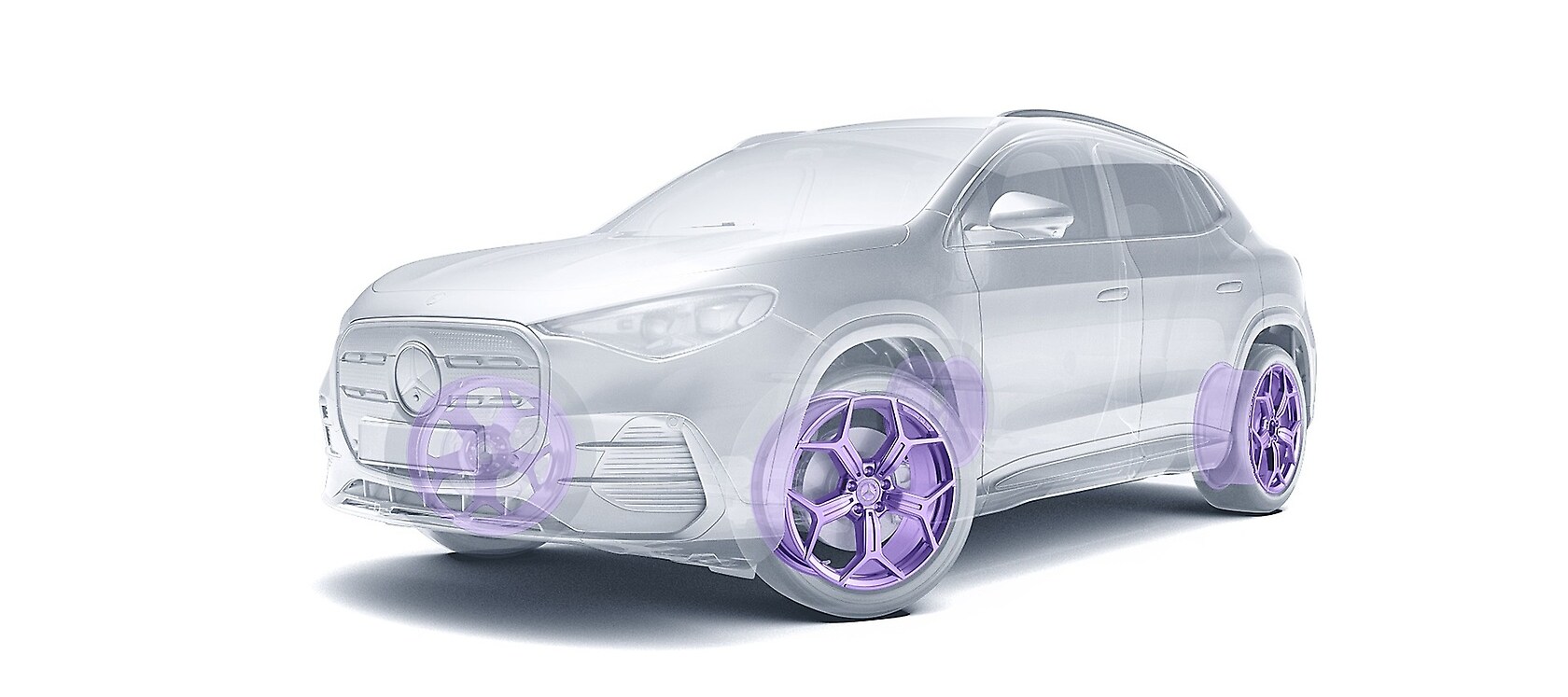
Transparency is a key element of the company’s due diligence approach. The fourth Raw Material Report provides insights into transparency, traceability and due diligence activities as part of Mercedes-Benz’s systematic assessment of 24 critical raw materials, with a particular focus on steel. Its findings informed the steel pilot. For the first time, the report is complemented by the “Transparent GLA”, an interactive format showing 19 raw materials used in selected components of the new GLA.

Mercedes-Benz Sustainability Dialogue 2026.

Sustainability Dialogue 2026.

On 10 November 2026, the Mercedes-Benz Sustainability Dialogue 2026 will bring together members of the Board of Management and external guests to discuss sustainability in the context of geopolitics, technological innovation and competitiveness.