May 08, 2026 – Mercedes-Benz has published the 360° Environmental Check for the all-new electric GLB, documenting progress in CO₂ reduction across the entire value chain.
,xPosition=0,yPosition=0.5)
Environmental Check
Mercedes-Benz AG
Mercedesstraße 120
70372 Stuttgart
Germany
Phone: +49 7 11 17-0
E-Mail: dialog@mercedes-benz.com
Please send queries about content on this website to any contact. You can address your concerns to us in English and your respective national language.
Represented by the Board of Management:
Ola Källenius, Chairman; Jörg Burzer, Mathias Geisen, Olaf Schick, Michael Schiebe, Britta Seeger, Oliver Thöne, Harald Wilhelm
Chairman of the Supervisory Board: Martin Brudermüller
Court of Registry: Stuttgart; commercial register no. 762873
VAT ID: DE 32 12 81 763
All information about our products can be found on your country-specific Mercedes-Benz product page.
Environmental Check
May 08, 2026 – Mercedes-Benz has published the 360° Environmental Check for the all-new electric GLB, documenting progress in CO₂ reduction across the entire value chain.
As early as the production phase, specific measures already enable around 21% lower CO₂ emissions compared to production without these optimisations.
This is based on the consistent implementation of decarbonisation measures in close collaboration with suppliers, as well as the increased use of renewable energy and CO₂-optimised materials. Particularly emission-intensive components such as battery cells, aluminium, steel and thermoplastics have been systematically addressed.
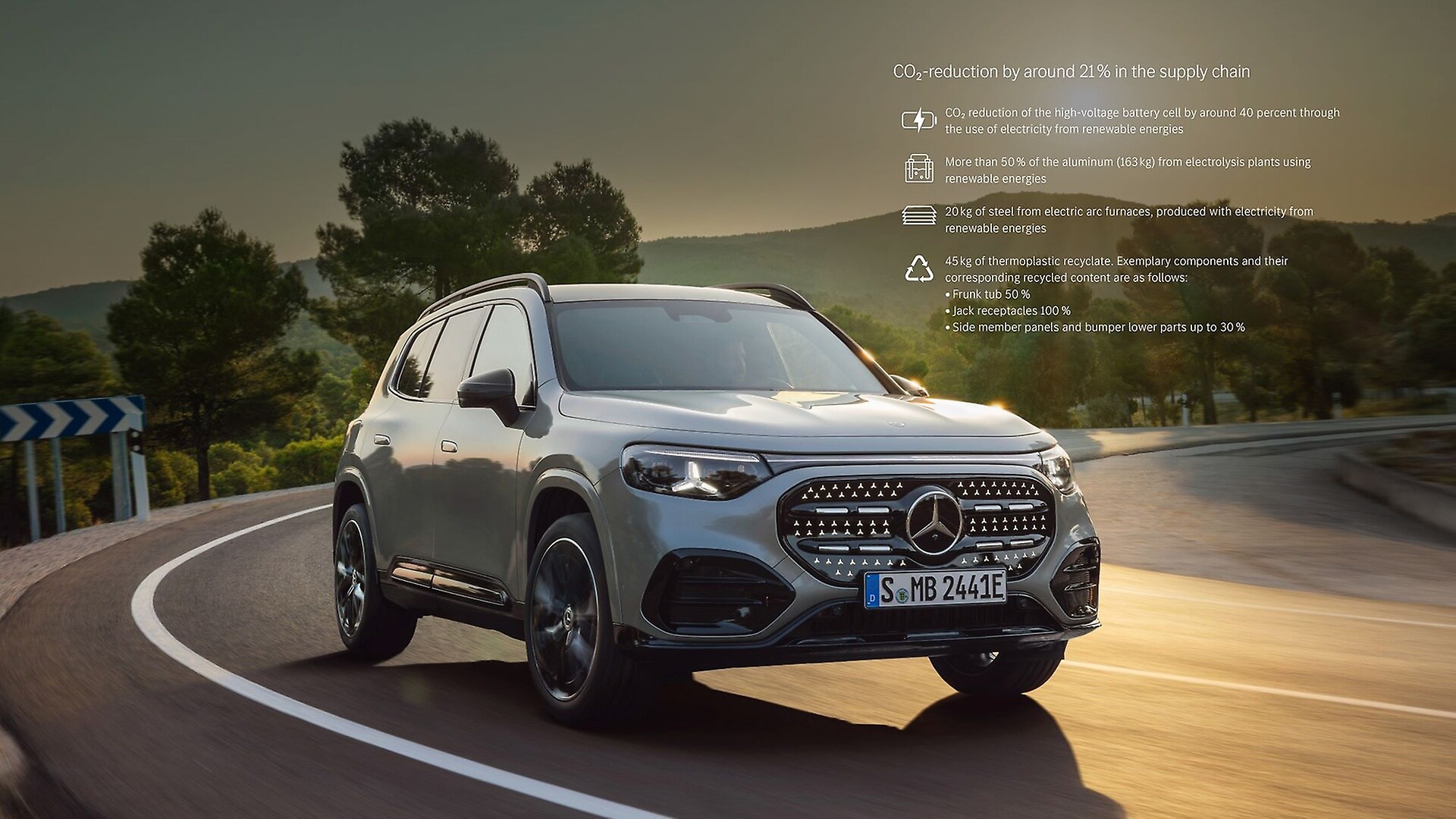
A key lever is the CO₂-reduced high-voltage battery: the use of electricity from renewable sources in cell production reduces the carbon footprint of the battery cells by around 40%, corresponding to savings of up to 2.8 tonnes of CO₂. Significant progress has also been made with aluminium: more than 50% of the material used (163 kg) comes from production powered by renewable energy, resulting in savings of around 0.6 tonnes of CO₂.
In addition, Mercedes-Benz is increasingly using CO₂-reduced steel and recycled materials. A total of 45 kg of thermoplastic recyclates are used, resulting in savings of around 71 kg of CO₂ compared to primary materials, while at the same time promoting the circular economy.
,xPosition=0.5,yPosition=0)