The British electric motor specialist YASA built upon the fundamental principle of the axial flux motor and developed an innovative prototype on which the current motor is based. Since YASA became a wholly owned subsidiary of Mercedes-Benz AG in 2021, Mercedes-Benz has consistently further developed the technology. This applies to both the product itself and the production process in order for both to meet the requirements of automotive mass production, high performance, and continuous load capability. One example: The axial flux motor on the front axle reaches speeds of more than 15,000 revolutions per minute.
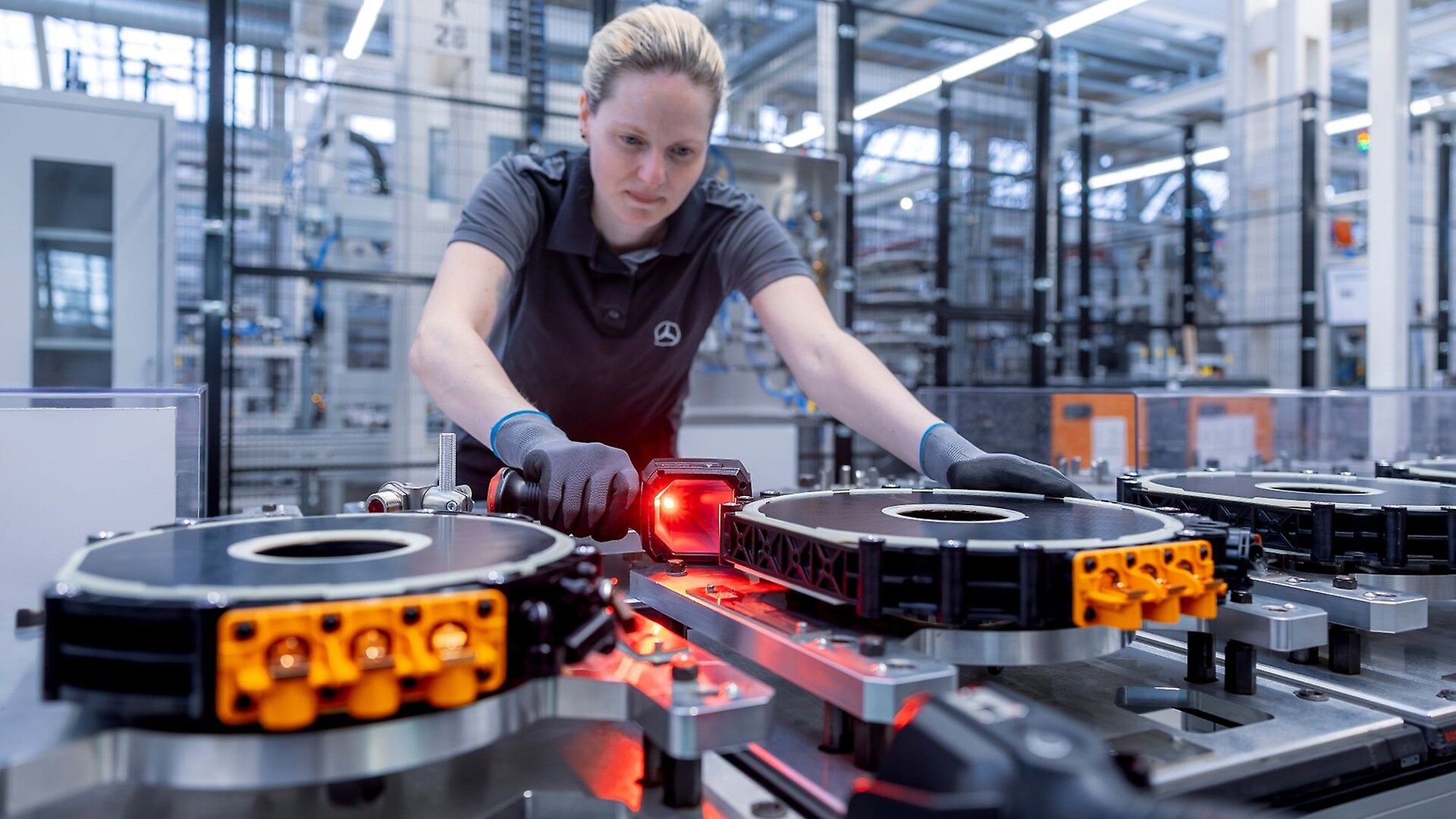
In contrast to conventional radial flux motors, the electromagnetic flux in an axial flux motor runs parallel to the axis of rotation. The key components are arranged in a disc‑shaped layout: two rotors sandwich the stator from the left and right. This design enables an especially compact motor architecture, high power and torque density, and new freedoms in drivetrain packaging. In the new Mercedes‑AMG GT 4‑Door Coupe, the motor at the front axle is just under nine centimetres wide; the two motors at the rear axle each measure around eight centimetres in width. The three axial flux motors are integrated per axle into so‑called High Performance Electric Drive Units (HP.EDU), where they are combined with a compact input planetary gearbox in a single housing.
The new Mercedes‑AMG GT 4‑Door Coupe clearly demonstrates the performance potential of this technology. The all‑electric performance model accelerates from 0 to 100 km/h in as little as 2.1 seconds and reaches a top speed of 300 km/h with the Driver’s Package. Its capabilities were also demonstrated the previous year by a spectacular record run in Nardò with the technology demonstrator CONCEPT AMG GT XX: over seven days and 13 hours, it covered more than 40,000 kilometres and set 25 long‑distance records.
,xPosition=0,yPosition=0.5)


,xPosition=0.5,yPosition=0)
,xPosition=0.5,yPosition=0)