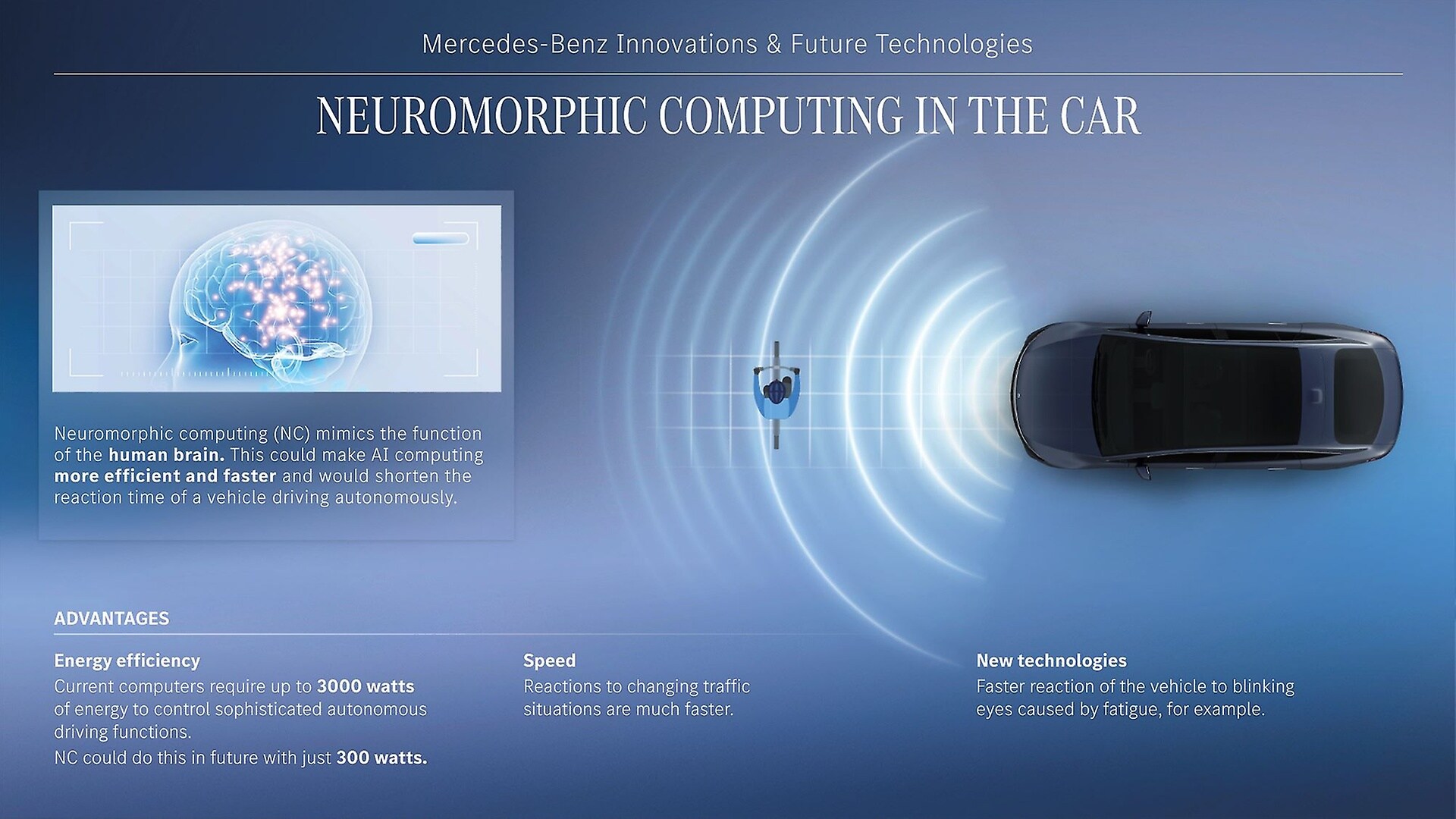
Through research into artificial neural networks, Mercedes-Benz and its partners from research and industry are breaking new ground in the creation of computer architectures. The company recently announced a research cooperation with the Canadian University of Waterloo in the field of neuromorphic computing. By mimicking the workings of the human brain, neuromorphic computing could make AI computations significantly faster. Safety systems could, for example, recognise traffic signs, lanes and other road users much better and react faster, even in poor visibility. There would be benefits in using a neuromorphic camera for interior monitoring, for example. Instead of full images (frames), it delivers individual pixels (events – hence the name event-based camera). The process is extremely fast with minimal delay. This means, for instance, a rapid system reaction to the blinking of a driver’s eye caused by fatigue.
,xPosition=0,yPosition=0.5)
,xPosition=1.0,yPosition=0)
,xPosition=1.0,yPosition=0)
,xPosition=0.8,yPosition=0)